
The economics of running an ecommerce store have quietly been turning upside down for years. Customer acquisition cost (the ad spend, content, and platform fees to find new buyers) keeps going up. Average order values are flat or up modestly. Repeat-purchase rates remain stubbornly low for most merchants. Customer acquisition math gets squeezed every quarter: acquiring new customers costs more, but the ones you get aren’t appreciably spending more, or more often with your brand.
The merchants who grow aren’t the ones who got smarter at advertising — they’re the ones who tweak the other side of the equation, and get more value from every buyer they bring through the door.
Digital sellers (or mixed stores, selling shippable and virtual items) benefit substantially from this math. Once you’ve spent $40 in ad cost to acquire a $50 customer, the next $50 you can get them to spend is almost pure margin.
Increasing repeat purchases and AOV is deceptively hard — and the hard question is how to wire digital products into your existing store so that every physical good sold, every email subscriber, and every checkout becomes worth meaningfully more than it was last quarter.
The CAC squeeze
If you’ve been running a store for more than a couple years, you’ve already felt the CAC squeeze. Everything costs more: Meta CPMs are higher, search ad costs are higher, and organic reach is harder. The customer who used to cost you $20 to acquire now costs $35. The math hasn’t broken yet, but the comfortable margin is gone.
The reflex most folks have is to drive CAC back down: work on better creative, better targeting, and better landing pages. That works for a bit, but you can’t cut your way to success — you can only ever save part of your CAC (and won’t grow by any more than that). As long as your goal is “acquire customers cheaper,” you’re focusing on the wrong side of the equation in the face of rising prices.
The other lever is LTV (lifetime value per acquired customer). A customer who buys once at $50 has a $50 lifetime valueto your brand. The customer who buys once at $50 and then buys a digital add-on at $30 has an $80 LTV. The customer who buys a $50 physical item, a $30 digital product, and joins a $9 per month membership has much more.
Digital products are the highest-leverage LTV lever most stores haven’t fully used. Digital goods have no marginal cost, no inventory risk, and no shipping. Once you’ve made the file, every additional sale is gross profit (minus payment processing). And most stores can offer digital complementary products or memberships to lift LTV, regardless of what they sell.
Here are our top five strategies to add digital goods for any seller, roughly ordered by how easy they are to add to an existing store.
Option 1: The post-purchase digital upsell
The customer just paid, and their card details are saved. Their “purchase intent” mental gate is wide open, and gives you a golden opportunity. Adding a one-click digital upsell to the thank-you page is the lowest-effort, highest-conversion play in the stack.
Imagine this: your customer buys a $40 physical product, then sees a thank-you page offering a $19 digital companion (extended guide, source files, video walkthrough, bonus content) with a single button to add it to the same payment method. No new cart, no duplicate checkout to complete.
Post-purchase upsells are effective for several reasons.
- The customer is already past the, “Should I buy from this brand?” decision.
- The dollar amount is often small relative to what they just paid.
- The companion product is obviously relevant (the digital file is the natural extension of what they bought).
- The friction is near-zero — just a single click.
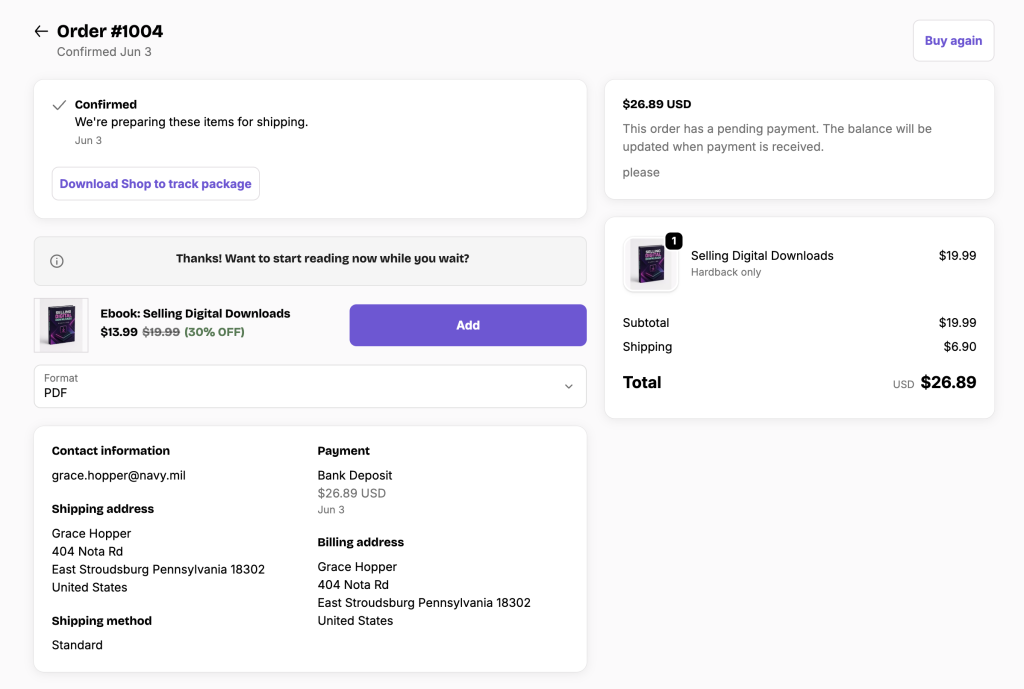
Conversion rates on well-designed post-purchase digital upsells can convert 8-15% of buyers and significantly boost LTV. For a store processing 1,000 orders a month at an $80 AOV, that’s 80–150 extra $19 sales, and $1,500 to $2,850 in almost zero-margin revenue against the same acquisition costs.
When designing your own upsells, consider how the upsell relates to the original purchase, both in terms of utility and price.
- Do not make the upsell required to get value from the original product. That’s not an upsell, it’s a bait-and-switch. (For example, offering an unlock key with software, or a proprietary battery with electronics.)
- Be conscious of upsell price vs original price. $19 next to a $40 purchase is “small extra.” $59 next to a $40 purchase is a new purchase decision, and unlikely to convert.
- Don’t offer too many things. The best-designed flows offer a single clearly framed upsell. Offering too many upsell options can trigger decision fatigue, and looks too “ad-like” to get attention.
The digital upsell needs to deliver to the customer immediately, get attached to the same order, and trigger the same download experience. Fileflare works really well with post-purchase apps like AfterSell to deliver a digital upsell from the thank you page.
Option 2: The physical + digital bundle as default
The simplest version of LTV expansion is to never sell the physical alone in the first place. If your physical product naturally pairs with digital content (instructions, source files, video tutorials, lossless audio, printable extras), the default offer is the bundle — and you let buyers downgrade to physical-only if they really want, or make that variant less obvious to find (defaulting to a bundle).
For example, music sellers on Fileflare often offer a vinyl release where the digital download is included with every physical pressing. The buyer who wanted the vinyl gets the digital almost as a perk; the buyer who would have just downloaded buys the vinyl, too because the increment is small. Merchants net the same AOV, but with better positioning.
We’ve covered the mechanics of physical + digital bundles for more detail on how to set them up.

Option 3: Order threshold free gifts
“Free shipping at $75” is the standard version of an order threshold, designed to increase AOV. The digital equivalent is more interesting because the cost to you is genuinely zero: “Free [digital companion or gift] when your order totals $75.”
This model can work well for small catalogs, where you can offer a universally-desired digital add on to boost order totals, or if you have enough digital companions to make the offer to most shoppers, depending on what’s in the cart. A customer whose cart total is at $65 will often add another $15 of products to clear the bar, if the offer is reasonably compelling, ratcheting your AOV up with minimal costs. (And customers who are already above your threshold feel like they were rewarded for spending more.)
The difficult part in landing this strategy is making the free gift or bundled digital product compelling — if your digital add-on is thin or feels like an afterthought instead of a real product, expect refund requests from folks who added non-essential items to get it.
Let’s take a look at some real-life examples of this strategy in play.
- Pattern + sewing-kit shop: Offer a free 3-pattern PDF bundle (normally $29) with orders over $60. The free bundle can push the average buyer from a one pattern SKU to a kit + accessories.
- Coffee roaster: Give a free brewing-method or home-roasting video course (normally $24) with orders over $50. This can help push the single-bag buyer to a two-bag-plus-gear order.
- Fitness brand: Include a free 4-week or travel training ebook (normally $39) with orders over $80 (especially if you can target the digital add-on based on the gear they’re buying). The educational materials supplement the apparel or gear easily.
The threshold you target should be 25% to 50% higher than your current AOV. If you set the target too low, you give away the digital item for no reason (folks spend that amount anyway). But, the target still needs to feel close enough for most shoppers that adding a little more to the order doesn’t require new purchase consideration.
Option 4: The digital subscription
This is the play that flips one-time revenue into recurring revenue, which fundamentally changes the unit economics of your business.
A digital subscription isn’t necessarily a software product, but it does require more effort than a “create once and sell forever” ebook. You can offer:
- Serial content, like a weekly recipe drop, monthly printable pack, or weekly newsletter PDF with depth that wouldn’t fit in an email. Videos or episode series for a podcast or show fit well with this model, too.
- Ongoing education, such as a course that releases new modules over a year, or a skill-development membership with new tutorials each month.
- An evolving library. Templates, presets, fonts, sound packs, brushes are great options for selling library access — the library can hold just about anything where the value increases over time as the library grows.
- Community + content, like a membership where the recurring value is part files, part access, part community.
Each of these turns a customer who would have paid $50 once into a customer who pays $9 to $29 per month. Every existing buyer is a potential recurring revenue stream, not just a one-time transaction.
Subscription-based products offer the most compelling math in this post. A store with 1,000 customers per year acquired at $30 CAC + average $50 order generates $50,000 per year in revenue. The same store with the same 1,000 customers, but with 15% of them on a $15 per month digital subscription will generate $50,000 from purchases plus $27,000 every year from subscriptions. The CAC and customer count are unchanged, but the revenue is up 54% — and the recurring portion can compound, because most of last year’s subscribers keep paying as you add new ones.
This is where Zendra — our sibling app — is a good fit. Zendra is a Shopify-native membership and recurring-revenue platform built around exactly this use case: gating digital content (files, courses, video, drips) behind subscriptions. Fileflare delivers digital products; Zendra controls who gets exclusive access and when.
Option 5: A serialized digital (“ebook as subscription”)
While this is similar to option four, it’s a wrinkle worth calling out because it gets dismissed by digital sellers who think it’s not how their format works.
Instead of selling a $29 ebook as a one-time purchase, you can sell the same ebook as a 6-month drip at $7 /month. The first month delivers chapters 1-2; the second month, chapters 3-4; and so on. The total revenue from a single subscriber increase to $42.
Serialized content works as a subscription for a few key reasons.
- The decision to subscribe is smaller than the decision to buy a $29 ebook. $7 reads as low-commitment.
- The serialized format keeps the customer engaged for 6 months: they open emails and they’re a warm lead for the next product (which is a huge win and marketing headstart).
- Cancellation friction is real but acceptable. Even with a 15% cancellation rate across 6 months, your average revenue per customer beats the $29 price. You can also consider requiring at least 2-3 payments before cancellation to tilt this math further in your favor.
- And emotionally: sometimes customers just like having something to look forward to. Anticipating a new chapter once or twice a week feels like a nice gift or pick-me-up to the week, improving your brand and product affinity.
There are a number of content models where serializations works well, even if it doesn’t seem to be an obvious fit.
- Fiction authors can release a serialized novel chapter-by-chapter. This is similar to the Substack pattern, but on Shopify with Fileflare delivery.
- Educators can drip course content, such as a 12-module course dripped over 12 weeks at $12 per week (for example, generating $144 vs a $99 lump-sum).
- Reference material can be sold as a monthly research drop on a niche topic. People who would download a free PDF once now pay $4 a month for ongoing depth delivered to them as research concludes.
- Creators can sell templates in drip-released bundles. A set of 24 templates can be released 2 per month at $9 /month. ($108 total vs an $89 lump-sum)
Even if you don’t think customers will subscribe vs paying the lump sump, you can use the subscription as a price anchor.
- Before: $99 lump sum for a 12-module course
- After: $12 per week, with one module per week, at $144 total cost. Offer a “pay up front” discount and sell the course for $115 (20% off!) — anchoring the up-front fee against the subscription total makes it feel like a deal vs showing $99 in isolation, while still driving up your AOV.
The serialized model isn’t right for every product. Buyers who want the whole thing now may be annoyed, but people who want regular new content will love it. If you’re not sure what your customers prefer, offer both and let them choose.
Zendra also supports one-time vs recurring membership purchases, so you can still use access or content as a perk for this digital purchase.
Pulling your digital offering together
These five options can feed off one another, and be used together. Start with one, and add others over time. For example:
- Add digital products to your order flow. Customers land on a physical product page, but the default variant is bundled with a digital companion.
- Upsell in your cart: offer a free digital bonus once the cart hits $75.
- Sell on your thank-you page. Add a one-click digital upsell: “Add the extended version for $19”.
- Create a post-purchase email sequence. On day 14, send an offer to join the monthly subscription for new content. On day 30, include an offer to join the serialized version of a related ebook.
The same $30 CAC that used to produce a $50 customer could now produce a customer with $80+ in initial revenue, plus a $10 per month recurring stream. Now in the face of growing marketing costs, your unit economics are far more favorable, all from adding low-to-zero cost digital goods.
I’ll caveat with this: not every store will have an obvious path towards digital add-ons. One-off art prints or custom-made purses can’t turn into a digital subscription. But, thinking in terms of complements (an art zine, digital proof, or style lookbook) can surface opportunities to introduce a digital catalog.
The toolkit for the job
To add digital products that drive higher AOV and LTV, you’ll need new tools.
- Reliable file delivery for the digital products themselves (the files have to arrive, be downloadable, and remain accessible).
- Access control for subscription or gated content (only subscribers see this; cancellations remove access; trial users get the right scope).
- Recurring billing for subscriptions (cards charge monthly, dunning handles failures, customers can self-manage their billing).
Using Fileflare + Zendra hits all three points. Fileflare handles file delivery, watermarking, fraud protection, and variant-level attachment. Zendra handles memberships, recurring billing, content gates, drip schedules. And if you want to add in upsells or cross-sells, check out apps like AfterSell.
The CAC squeeze isn’t going to ease, and acquisition will only get more expensive from here. The merchants who keep growing will be the ones who can optimize acquisition, and add more revenue per customer. Digital products, when used well, are a super high-leverage way to make that math work on a Shopify store.