
Pricing digital products is a (mostly) psychology problem dressing up as a math problem. Downloads have no inventory to house or clear, no cost of goods to amortize, and no shipping to absorb — the marginal cost of selling more units is basically $0. Price isn’t constrained by cost; instead, it solely reflects what the buyer believes the product is worth, and how much they’ll pay for it.
The infinite flexibility makes pricing a digital product both easier and harder than physical products. You have almost unlimited room to position your product ($0.99 or $99 or $999), but the anchors that physical products give you (materials cost, shipping cost, competitor MSRP) don’t apply, and thus make pricing super variable.
Most digital sellers solve this by either underpricing wildly (the $3 ebook that should be $29) or overpricing in a way that crushes conversion (the $497 course that should be $97).
This post is an exercise in thinking through pricing digital goods to land somewhere that converts without giving away value.
The three jobs of a digital price
Price isn’t just a number; it’s a signal to potential buyers.
- It signals quality. Buyers infer value from price. A $9 ebook reads as “probably thin, probably AI-generated, probably worth skimming.” A $49 ebook reads as “the author took this seriously and so should I.” This isn’t always true; but it’s how buyers behave before they’ve read the thing.
- Price filters your audience. Higher prices select for buyers who are more committed and lower-maintenance. Lower prices attract more buyers but a higher proportion of refund requests, support tickets, and one-star reviews from people who never actually wanted the product.
- It frames what comes next. A $20 product is a one-time buy. A $200 product is the start of a relationship — they expect more support, more updates, more access. A $2,000 product is a project — buyers expect handholding and outcomes. Price sets customer expectation for different outcomes.
When every day feels like a grind, it can often be that your price has one of these three concepts misaligned. A $9 product with a $200-level support promise will burn you out. A $200 product with a $9-level deliverable will get refunded.
Why “cost plus margin” doesn’t work
The default pricing formula most merchants reach for is cost-plus: figure out what your item costs to make, add the margin you want, and that’s the price. For digital products, this falls apart immediately because:
- The cost of producing one unit is essentially zero. Your effort and time went into making the master file, not the copy that gets delivered. Amortizing your time across an unknown number of future buyers gives you a meaningless number.
- Your costs don’t scale with units. Adding more buyers doesn’t add more cost (within reason). So margin-per-unit gets weirder the more you sell — a 90% margin on 100 sales becomes a 99.9% margin on 10,000 sales, and the cost calculation gives no useful signal in either case.
- Buyers don’t know or care about your cost. They care about the value to them, the price of comparable products, and what their wallet can absorb today. Your costs are irrelevant to their decision.
The right framework for digital is value-based pricing: what is this worth to the buyer, and what will the market support? The math is downstream of those two questions.
Three anchors that work
Cost isn’t a useful anchor to price digital goods, but there are others.
1. Comparable products
What are buyers currently paying for products that solve the same problem? If there’s a $39 cookbook on the same cuisine, yours is anchored at $39. If competitor courses on the same topic are $197-$397, yours should be in that range unless you have a reason to break it. Convention beats cleverness.
The trap in this logic is in comparing yourself to the wrong reference class. A 60-page PDF guide is not comparable to a free Wirecutter article, and pricing it low just because free alternatives exist leaves money on the table.
The right comparison is what buyers pay for similar packaged knowledge: Kindle ebooks at $9.99 if it’s a casual read, Udemy courses at $19-$199 for tutorials, professional reference materials at $79-$299 for niche depth.
2. The outcome value to the buyer
For products that create a measurable outcome — saving time, making money, learning a skill that pays — the buyer’s mental math is what does this outcome cost me right now, and how much cheaper is it to buy this thing?
A $97 spreadsheet template that saves an accountant 10 hours of setup work is “obviously cheap” if the accountant bills at $100 /hr. A $497 course that helps a freelancer raise rates by $20 /hr “pays for itself” inside a couple billable hours.
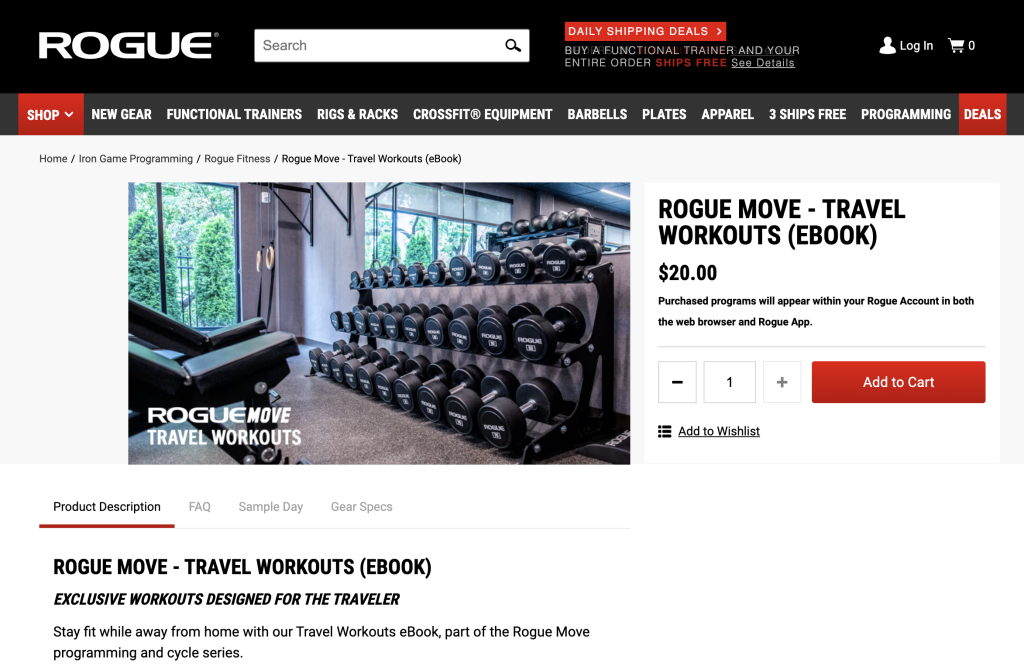
This “math” doesn’t have to be work-related, either. Take this example from Rogue: a $20 ebook on travel workouts saves time planning or looking up new exercises, and might have some hidden tips on exercising with limited equipment. For someone who cares enough about fitness to worry about maintenance while traveling, a $20 price is low enough to feel like they’ll get great value — especially when anchored against their gym membership or trainer fees.
If your product creates a quantifiable outcome, price against the outcome, not against the artifact. Buyers who do the math will sell themselves on it.
3. What the buyer can absorb without thinking
Different price ranges trigger different decision processes. Almost any seller can price up to ~$20 for a download, but commanding a higher price involves different decision-making for the buyer.
- Under $20: Can be an impulse buy. Conversion is driven by curiosity and immediate desire.
- $20–$100: Takes some consideration. The buyer reads the description, looks at samples, thinks about it for an hour, maybe comes back to it. Conversion is driven by trust signals like reviews, sample chapters, or your refund policy.
- $100–$500: Typically a “researched” buy. The buyer compares alternatives, asks in communities, sleeps on it overnight. Conversion is driven by social proof and clear promises about outcomes.
- $500–$2,000: Considered by a group (even for personal purchases). The buyer justifies the purchase to themselves or their household. Conversion is driven by personal calls, money-back guarantees, and demonstrated past results.
- Over $2,000: Usually requires a sales process. High-priced digital goods almost always require a conversation, custom proposal, or deeper qualification step to close a sale.
The risk is sitting at the wrong end of a band. A $29 product priced at $49 loses some of the “impulse” mentality and moves more strongly into “Consideration required” territory — and will leak conversions if the social proof isn’t there to back it up.
Tiers, bundles, and the decoy effect
For most digital products beyond a certain price, a single price-point can leave conversions on the table. Offering multiple price points or ways to buy can close more sales, or increase average order value simply by having an upsell.
Three-tier pricing
The classic SaaS pricing layout — Good / Better / Best — works for digital products too. The Better tier is the one you want most buyers to land on; Good exists to make Better look reasonable; Best exists to make Better look like the smart middle choice.
You can apply this to a digital product, too.
- Basic ($X): The core deliverable. Good for buyers who want exactly that thing.
- Pro (~3-4× Basic): The deliverable along with things that make it more useful, like templates, scripts, examples, and bonus material.
- Premium (~3× Pro): Everything in Pro, along with access to a community, live calls, source files, or a level of service that’s hard to scale (like a consultation).
You can use Zendra alongside Fileflare to create member communities or provide gated access to content, member sales events, and listings to book calls.
Some folks come into pricing thinking that, “Premium must have 3× the content of Pro.” Instead, Premium adds a category of value (access, support, sources) that’s qualitatively different.
Bundles
A bundle works when the products are genuinely complementary and the bundle price feels like a deal. Anchoring the bundle against the sum of standalone prices works when the math is real: a $97 bundle that “would be $147 separately” reads as a 34% discount, and buyers will check the math.
Bundles need to ensure component value is high, though. Bundles where the additional digital products feel like padding will not convert. Customers don’t value a 5-product bundle more than a 2-product bundle if 3 are filler — and it’s usually more obvious than you think.
The decoy effect
The decoy effect is a pricing trick Dan Ariely popularized in Predictably Irrational: when buyers see three options and one is asymmetrically dominated by another, they pick the dominant one. The classic example is The Economist subscription at: Digital $59, Print $125, Digital + Print $125. Why does Print-only exist? To make the Digital + Print bundle look like a steal: same price, more product.
You can leverage decoys when you price digital products, ensuring that one of the variants in your line up serves to make the “right” choice look even better. If you want most buyers to land on your $97 tier, your $147 variant should make the $97 one obviously a great value. Your $47 entry tier should clearly exclude things buyers really want.
The decoy effect is real, but it’s also visible to attentive buyers. Don’t make the decoy comically bad, just make the “right” tier an obviously good choice.
Variable pricing for variants
If your digital product has variants for licenses, sizes, or bundles per buyer type, pricing the variants well is its own skill.
Fileflare merchants commonly use variants that capture more value from high-intent or professional buyers, to get more revenue from the same digital assets.
- Offer a personal vs. commercial license: Personal at $X, commercial at 3-5× that price. The commercial buyer usually generates revenue from the asset, so the price scales with their value.
- License a single-user vs. a team: Single-user at $X, team (5 seats) at ~3-4× X. The higher price reflects the value to a team (and gives a small scale discount) while remaining in sight of the team budget.
- Offer editable source vs. delivered PDF: This model works for templates, where you sell a stamped PDF at $X, but editable source files (like a docx) at 2-3× that price. Source files unlock customization and reuse, so the premium reflects optionality.
- You can also make sure you include a licensing file that makes it clear re-sale is forbidden, and outlines other acceptable use.
- Branded vs. white-label: Branded version at $X, white-label (remove branding for resale or client work) at 5-10× your branded price. White-label is effectively a license to use your product as input to someone else’s business, so a much higher price reflects that value and time savings.
For Shopify merchants using Fileflare, our variant-level file attachment means you can deliver different files for each variant. A $29 personal license can get a watermarked PDF, while the $99 commercial license can get the un-watermarked PDF plus the editable source.
Common pricing mistakes
While we see a lot of inventive pricing among Fileflare merchants, we also see common mistakes, especially for new stores.
When you launch, avoid pricing the first product too low because you’re not sure anyone will buy it. This usually results in you anchoring all subsequent products against that low first-product price, and never being able to escape the floor. Start the first product at the high end of your estimated price range — you can always discount later.
And of course, while you can discount, avoid discounting consistently. “Black Friday 50% off” trains buyers to wait for the next discount. Use discounts strategically (e.g. a launch promotion, year-end clear-out, bundle-only) rather than as a regular tactic.
There are a few other concepts to think about, though these may or may not apply to your digital catalog.
- Consider whether you should use round numbers everywhere. $50, $100, $200 could read as arbitrary prices, while $47, $97, $197 can appear more thoughtful (when in doubt, do what feels standard for your industry or vertical). The effect isn’t huge, but it could be a free boost in how professional you appear.
- Remember that “free” is its own pricing decision. A free product attracts a completely different audience than a $9 product. Free may bring more visitors, but those folks might not be qualified leads, and can sometimes eat resources (like support) that cost you real money. Evaluate if your free downloaders actually end up buying from you to balance against the costs they can bring.
- Periodically raise prices. Even if your “costs” aren’t going up, value and purchasing power go up over time. Ensure your price consistently reflects the value it delivers, not what it cost you to make or what it’s “always been”.
The pricing framework
When pricing a new digital product, answer these questions to decide on your structure.
- What’s the comparable product / category price? Where does the market currently sit?
- Is my product a thinner, equivalent, or richer version of the category? Price below, at, or above the category midpoint accordingly.
- What’s the outcome value to the buyer? If quantifiable, is my price obviously a fraction of the outcome?
- What price band does this trigger (impulse / considered / researched / committed)? Is the deliverable consistent with the buyer expectations of that band?
- Should this be a single price or tiered? If tiered, what’s the smallest tier set (often three) that maps cleanly to buyer segments?
- How will I raise the price over time? Tentatively plan the first increase before launch so it’s not a panicked reaction.
Pricing is not the highest-leverage thing in your business; the product, the audience, and marketing all move the number more. But, pricing is the single decision that converts attention into revenue. Getting pricing right means buyers aren’t talking themselves out of the purchase before they finish reading the description; getting it wrong means watching abandoned carts add up while you wonder why.
And if you use Fileflare, we’re always happy to review your digital product setup, and provide feedback on pricing and merchandising.